
Board Toolkit
As a Reach Out and Read Colorado Board member, you play an essential role in supporting our mission to give young children a foundation for success by helping to raise the necessary funds that support the program.
THANK YOU!
In this toolkit, you’ll find everything you need to speak with confidence and knowledge about all things Reach Out and Read Colorado – from impact data and program logistics to personal stories and testimonials. It’s our hope that you’ll use the resources provided in this toolkit to help you have successful conversations within your circles – helping us to drive new partnerships, relationships, and support.
There are many ways to connect with someone about Reach Out and Read Colorado, and it doesn’t have to (always) be about a donation. We have created a number of suggested ways in which people can demonstrate their support – from hosting a gently-used book drive or a house party to supporting events or connecting local partners. All these things will help Reach Out and Read Colorado meet our FY2026 fundraising goal of $2.3 million.
Questions? Contact Amy Malik, Director or Development, at 303.623.3800 or amy@reachoutandreadco.org.
SHORTCUTS
Quick-links to the resources included in this toolkit
Here are a few of the easiest ways to get started:
- Connect with Reach Out and Read Colorado on social media
- Facebook- www.facebook.com/reachoutandreadcolorado
- Twitter- www.twitter.com/reachoutreadco
- LinkedIn- www.linkedin.com/company/reach-out-and-read-colorado
- *Once you ‘follow’ Reach Out and Read Colorado, please ‘like’ and ‘share’ posts whenever you feel inclined.
- Subscribe to our bi-monthly email newsletter (if you haven’t already) and encourage your network to do the same to stay up-to-date with everything Reach Out and Read Colorado! >
- Are you on LinkedIn? If so, please consider adding your volunteer experience as a Board member to your LinkedIn profile.
Use this language as a guide:- Organization: Reach Out and Read Colorado
- Role: Board Member
- Date: (start + click “I currently work here”)
- Description: www.reachoutandreadco.org
- Reach Out and Read Colorado is a 501(c)(3) non-profit organization whose mission is to improve school readiness and social-emotional skills through trusted literacy guidance and reading together. Reach Out and Read Colorado allows healthcare providers to talk with parents of young children about the importance of reading aloud at regular well-child visits with a special focus on children growing up in poverty. By building on the trusted, consistent relationship between parents and healthcare providers, Reach Out and Read Colorado helps families and communities encourage early literacy skills and healthy parent-child bonds so children enter school prepared for success. Reach Out and Read Colorado currently works with over 2,000 providers in 330+ medical offices to serve children all across the state.
Boilerplate Language: What is Reach Out and Read Colorado?
Here is a boilerplate description that you may use when you’re initiating conversation about the organization. We encourage you to save all the in-depth details for a deeper in-person conversation.
Reach Out and Read Colorado is a nonprofit organization that improves school readiness and social-emotional skills through trusted literacy guidance and reading together.
Reach Out and Read Colorado empowers healthcare providers to talk with parents of young children about the importance of reading aloud at regular well-child visits, with a special focus on children growing up in poverty. By building on the unique relationship between parents and healthcare providers, Reach Out and Read Colorado helps families and communities encourage early literacy skills and healthy parent-child bonds so children enter school prepared for success.
Reach Out and Read Colorado currently partners with 330+ medical offices throughout the state to provide books and literacy guidance to children and their families at nearly 340,000 well-child visits each year.
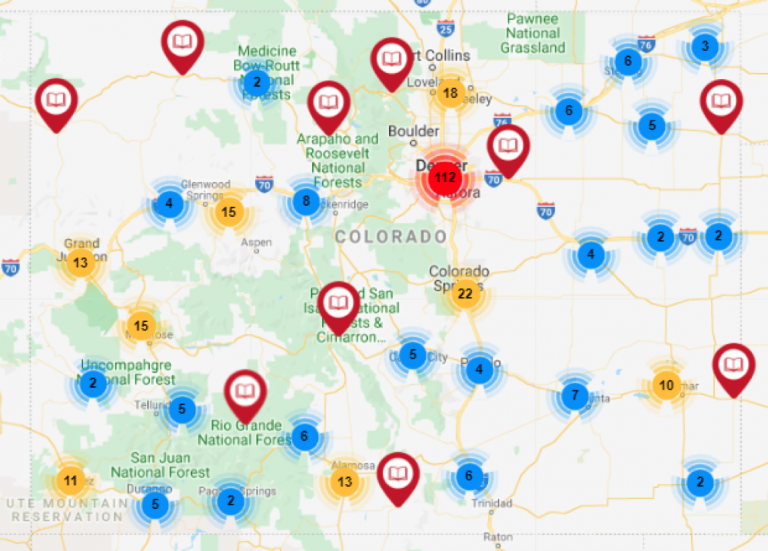
Where We're Located
Are there Reach Out and Read Colorado partner providers in the communities you care most about? Reach Out and Read Colorado partners with healthcare providers to serve children from all of Colorado’s 64 counties.
Program Logistics
Reach Out and Read Colorado’s program model is made up of three components: 1) a brand new, developmentally- and language-appropriate book, 2) anticipatory guidance discussed by a healthcare provider and 3) a literacy-rich clinic environment.
Reach Out and Read Colorado prioritizes partnerships and healthcare providers who serve a high percentage of children and families living in poverty. Once a healthcare practice becomes a part of Reach Out and Read Colorado, the program is a lever that fundamentally changes the way providers conduct a well-visit, bringing a cultural shift that benefits all children within that clinic location.
Reach Out and Read Colorado’s work begins in the clinic waiting room, by providing a literacy-rich environment, utilizing gently used books for family members that reinforce provider messages about the importance of early literacy and benefits of reading aloud. Books are offered to siblings of all ages to support shared reading time for the whole family. In the exam room, providers utilize the new book given as a diagnostic tool, using it to help parents understand their child’s developmental growth and the value that reading together provides in their child’s development and eventually, school readiness.
The shared responsibility of program implementation – anticipatory guidance from the provider and practiced by each family is as unique and diverse as this great state. Together, with 334 medical offices, from the mountains to the plains, we are creating change and possibility for Colorado families.
The Need for Our Program
The so-called “Opportunity Gap” is real and measurable. It actually sets its roots at birth, continues through early childhood, and will by kindergarten, deliver lifelong negative consequences without early intervention.
Physiological analysis of the brain reveals developmental gaps are evident beginning as early as 18 months, growing more pronounced in early childhood. Children living in poverty are exposed to significantly fewer words in the early years than their affluent peers. As a result, this most vulnerable population is plagued by a systemic inequality, yielding a precondition of permanently poor health. When children begin kindergarten behind, data show they are likely to remain behind and are 3-4 times more likely to drop out of school. National data reveals 85 percent of all juveniles who come into contact with the juvenile court system are functionally illiterate; this has dire health implications not only for the offenders, but for entire communities.
Children who are read to during infancy & preschool years have better language skills when they start school and are more interested in reading. Parents who spend time reading to their children create nurturing relationships, which is important for a child’s cognitive, language, and social-emotional development.
- The more words children hear spoken to them from birth, the more words they learn.
- One third of children start kindergarten lacking the basic language skills they will need to learn to read.
- Children learn best from speech directed to them by caregivers, creating conversations that build on children’s interests.
Why Books
Because there’s a lot of power between those pages.
- The most important activity for building knowledge for eventual success in reading is reading aloud to children.
- Access to books is the single most important indicator of academic success.
Why Now
The earlier the intervention, the greater the benefit.
- A child’s brain undergoes an amazing period of development from birth to three—producing 700 new neural connections every second.
- 90% of a child’s brain develops before age five.
Why Providers
Healthcare providers have consistent and early access to families and are a trusted source of health information.
- Making books a part of preventative visits allows healthcare providers to observe fine motor skills, language, literacy, and parent-child interactions, and providers guide parents with the information they need to develop healthy habits for daily reading aloud.
- The unique intersection between trusted expert (doctor/healthcare provider) and a child’s first and best teacher (parents/caregivers) allows for the critical dialogue and modeling that can lead to a strong family daily reading practice.
Research / Proven Results
Research shows that when pediatricians promote literacy readiness according to the Reach Out and Read model, there is a significant effect on parental behavior and attitudes toward reading aloud, as well as improvements in the language scores of young children who participate. These effects have been found in ethnically and economically diverse families nationwide.
Research shows that families served by Reach Out and Read have more books in their homes, are more likely to read with their children, and have greater language development than those without access to the Reach Out and Read model.
Our research shows that in families served by Reach Out and Read:
- Parents are 250% more likely to read to their children
- Parents are 200% more likely to read to their children more than three times a week
- Families are 250% more likely to enjoy reading together or have books in the home
- Children’s language development is improved by 3-6 months
- Children’s language ability and vocabulary improves with increased exposure to Reach Out and Read
VIDEO LINKS
Sometimes a video tells the story best.
You might also copy and paste these links into the Reach Out and Read Colorado contact info on your phone for handy viewing.
You can always visit or send someone to our YouTube channel to check out some videos that zero in on a particular aspect of our story.
make sure this toolkit is always at your fingertips!
Please save this toolkit somewhere easily accessible or create a new contact in your phone called “Reach Out and Read Colorado,” add this URL to the contact information, and use the Notes section to add the links or data points that you use most frequently